Subscribe to SoftLogica
Newsletter to get 10% discount on newly
released products!
Graphs for Individual Pages
Creating a Test Scenario
To perform a test, you should create a test scenario. WAPT
test scenario defines parameters of test run: the number of virtual users,
test duration, date and time when the test will be started, user simulation
options and the list of included user
profiles. Scenario also contains options for saving log files and
test results.
To create a new test scenario, click the New button
on the program toolbar. New
Test Scenario Wizard will be initiated. This wizard will help you
create a new test scenario depending on your testing objectives. It also
includes a short guide on test results. With the help of New Test Scenario
Wizard, you can define user load, test duration, user simulation options
and add user profiles to the new scenario.
You can modify the properties of created test scenario. For this,
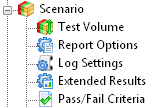
click on Test Volume or Log and Report Settings view in Navigation Pane. Scenario options will be
displayed in the right pane. Here you can view and modify scenario properties.
Test Volume
In Test Volume view, you can specify the number of virtual users participating in test run
and test duration.
You can set either a fixed user load, or perform a test where the number of virtual users is gradually increasing
until it reaches the specified maximum.
Fixed user load
If you need to make a fixed load on a tested server, you can
specify a constant number of users that will be active during the whole
test run. All users will start simultaneously at the beginning of the test.
Ramp-up: users from _ to _
If you wish to perform a test where the number of users is gradually increasing,
you should select the option with ramp-up number of users and
specify initial and final values of interval and some step. You can also set a
delay between virtual users.
The number of users will increase gradually during test run until it reaches
the specified maximum.
User load table shows all profiles of current test scenario with initial
and final number of virtual users, and percentage of each profile from the total
number of users. You can edit the Final Users column:
select the row with desired profile,
double-click on its value in the Final Users column and enter the needed value.
The total number of users (the sum of all profiles)
will be recalculated automatically (see outlined edit boxes on the screenshot above).
Other columns of user load table are not accessible for editing.
User load graph shows how the number of users
changes with time during the test.
Red vertical line on this graph indicates the end of test run.
In trial version of
WAPT, the maximum number of virtual users is limited to 20. In registered
version of the product, this number is unlimited.
Run time: Specify test duration (time format is hours : minutes : seconds).
Run test at: Enables to schedule a test run if, for example,
you need to start a test at off-hours.
Select desired date and time and click the Run Test
button
on the program toolbar.
Note that scheduled run will be activated only after you click the Run
Test button .
If the specified time has already passed, the test will start immediately.
Log and Report Settings
In Log and Report Settings view, you can define options for saving
log files and test results.
You can set WAPT to create full logs or error logs.
Log files will help you know what occurred during test run.
Full log is a comprehensive log of WAPT test run that includes information on all requests, responses,
redirects and returned HTML code.
Error log contains page requests and responses for which an error occurred during the test. In other
words, error log contains those requests for which HTTP reply code is not equal to 200 (OK).
Note that creating logs could require much space on the disk. Logs are often used for functional
testing or for debugging a test scenario with dynamic parameter values.
Log level of detail: Select the type of log file that will be created during test run.
Disable: No log files will be created.
Errors: For each virtual user participated in the test, Error log file will be
created.
Full: For each user profile participated in the test, Full log file will be
created. Full logs are created for the first user of each profile.
For other users, WAPT
will create error logs.
Save logs to: Here you can change the default location for created log files.
You can adjust WAPT to save test results in
CSV format and import them later, any
time you wish to Microsoft® Excel. For instance, you will be able
to make graphs there.
Save results to: Enables to save test results in CSV format in required location.
If you enable this option, then for each user profile, a file with test results will be created.
You can change the default location for CSV files.
Results file name pattern: It is the default pattern, which will
be used to generate names of CSV files with test results. Click
the Edit... button to modify
this pattern.
Test run comment: Here you can enter your comment for current test
run. This comment will be displayed in HTML
Report and Summary Report.
HTML report dimension: Here you can specify the number of columns that will be
used in some tables of HTML Report and Summary Report.
The whole test duration interval will be divided into the
number of intervals equal to HTML report dimension value.
The program will calculate the averaged data through these intervals and show it
in HTML Report and Summary Report.
Refreshing time: Here you can specify time period (in seconds) after which
the program will refresh the statistics of gathered data and refresh generated
graphs and reports. This will be done regularly during test run.
Default value of Refreshing time is 10 seconds. You cannot make this value less than 10;
you can only increase it.
If graphs generated during test run exhibit sharp fluctuations, then most probably the
Refreshing time value is too small, and tested server cannot execute an
adequate number of requests during this time.
You should increase the Refreshing time value to get correct results.
Note that the less is Refreshing time, the more resources of test machine will be
required.
Timing: Select desired timing unit (seconds, minutes or hours)
that will be used in tests. Depending on this option, the program will measure the number of
pages/hits either per second, or minute, or hour.
Saving a Test Scenario
You can save a newly created test scenario and open it later to continue testing
your site. Scenario file includes information on all user profiles of
current scenario, test volume options, user simulation options and settings
for saving log files and test results.
Click the Save button
on the program toolbar. You will see the Save As dialog. Type the
appropriate name for new scenario, select a location and click Save.
The file will be saved as a file with .wps extension. It is WAPT
4.0 extension for files with test scenarios.
If you wish to save changes made in the existing scenario, click the Save button
and all changes will be automatically saved.
After saving, the Save button becomes disabled.
WAPT displays test scenario name in the
title bar.
Opening a Test Scenario
You can open an existing test scenario and continue testing your site.
For this, click the Open button
on the toolbar and select desired scenario file.